
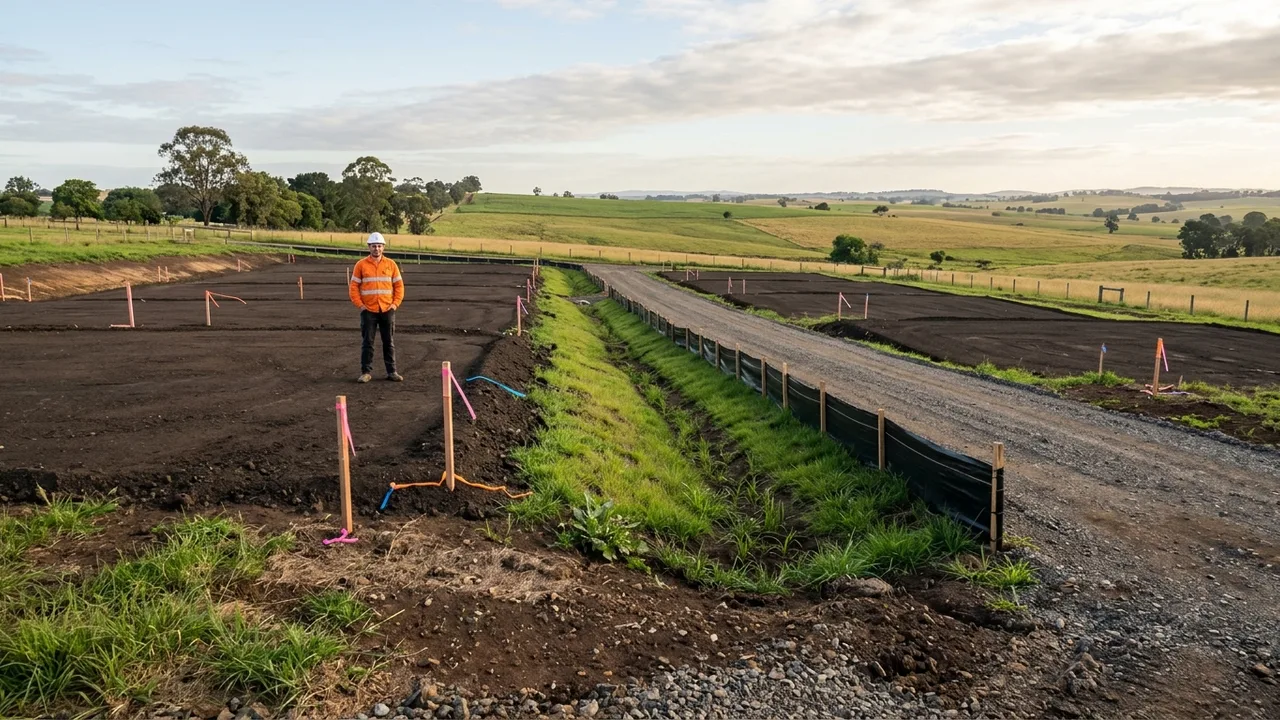
Subdivision Earthworks in Toowoomba
Lots can't be sold until the roads, drainage and pads are done. Subdivision earthworks in Toowoomba are worked stage by stage so early lots can settle while later ones are still being formed.
Subdivision earthworks in Toowoomba means cutting and filling a parcel into separate lots, then building the roads, drainage and service trenches that make each lot buildable. Contractors do this to your engineer's plans and council conditions, usually in stages, so early lots can be finished while later ones are still being formed.
What is included
- Lot formation Each lot is cut and filled to its design level so the builder gets a pad that matches the plans.
- Bulk earthworks Moving soil across the whole parcel sets the grades that roads and drainage depend on.
- Roads, kerb and channel Council conditions usually call for finished pavements and kerbing before a stage is signed off.
- Stormwater drainage Pipes, pits and swales carry water off the lots so it does not sit against future slabs.
- Service trenching Water, sewer and power need trenches cut to depth and grade before the surface is finished.
How it works
-
Read the approved plans
The contractor works through the engineer's drawings, council conditions and survey information to understand levels, staging and what must be certified.
-
Agree the scope and price
Cut and fill, roads, drainage and trenching are set out for each stage so you know what is covered before machines arrive.
-
Clear and strip the site
Vegetation and topsoil come off first, with sediment controls in place to keep dirty water on the site.
-
Form the lots
Bulk cut and fill brings the parcel to design level, with fill placed in layers and compacted so it can be tested where required.
-
Build roads and services
Trenches, drainage, kerb and channel and road pavements follow, so the stage is ready for inspection.
Subdivision earthworks in Toowoomba: from raw parcel to serviced lots
A subdivision turns one title into many, and the ground has to change to match. The engineer's plans fix the level of every lot, the fall of every road and the line of every drain. The earthworks contractor builds that design in the dirt.
Work usually runs in stages. Stage one might cover the roads and the first group of lots. Later stages follow as sales or finance allow. Planning the order well means machines are not tracking over finished work and each stage can stand on its own for council.
The same approach suits a small residential split, a larger estate or an industrial release. What changes is the volume of soil and the number of stages, not the logic of the job.
Detailed earthworks: cut, fill and compaction
Detailed earthworks start with the levels on the plans. Where the ground sits above design level it is cut. Where it sits below, fill is brought in and placed in thin layers, each one compacted before the next goes down.
That compaction is what lets a slab sit on a lot without settling. Where the approved plans require fill testing, arrange the specified tests and keep the results for the engineer and building certifier.
Clay soil holds water and softens after rain, so wet weather can stop work. A crew that knows this keeps the site shaped to shed water, protects open cuts, and does not push wet clay into a pad only to rework it later.
Excavation, rock and old pipes in the ground
Excavation on a subdivision is rarely just digging soil. Rock can sit below the topsoil, and old pipes, drains or fence footings can run through a parcel that has been used before. A geotechnical report, which is a soil and rock investigation, shows what the machines are likely to meet before the price is set.
Where rock does appear, the choices are usually to break it out, reshape the design level around it, or build a retaining wall. Each has a different cost, and the engineer decides which suits the lot layout.
Tree clearing matters here too. How much is removed affects lot yield, the soil volumes and where machines can work.
Roads, kerb and stormwater inside the estate
Roads in a subdivision are built from the bottom up. The formation is shaped to grade, pavement layers go on, then kerb and channel, which is the concrete edge and gutter that guides water along the street.
Stormwater is the part that goes wrong most visibly. Pipes and pits must fall the right way and discharge somewhere approved, or water pools against the new lots. Trenches for water, sewer and power are cut along the same corridors, so doing them in the right order avoids digging up finished road.
One contractor covering earthworks, roads and drainage keeps these trades from waiting on each other.
Who works alongside the earthworks contractor
A civil engineer in Toowoomba designs the levels, roads and drainage, and answers council's questions about them. Surveyors set out the boundaries and mark the design levels on site, and they check the finished work against the plans.
Many earthmoving crews now use GPS machine guidance, where the excavator or dozer reads the design surface and shows the operator how far to cut or fill. It cuts down on over-digging and rework when the plans are accurate.
Plan issues are worth catching early. Levels that do not match the survey, drains falling the wrong way, and batters drawn too steep are all easier to fix on paper than in the ground.
What drives the cost and the timeline
Cost follows the volume of soil moved, how far it travels, how much rock is in the way, and how many roads, drains and trenches the plans include. A site that balances, where cut roughly equals fill, costs less than one that needs fill trucked in or spoil carted out.
Timing depends on the same things, plus weather, staging and inspections. Wet clay can stop work for days.
A clear scope and price for each stage lets you plan finance and sales around the work. Licensing matters on a project like this, so confirm that the contractor holds the right licence for the work on your site.
Subdivision earthworks options
- Estate stage earthworks Bulk cut and fill for a residential or industrial stage, worked to the design levels on the approved plans.
- Lot pads and batters Compacted pads for each lot and shaped batters where one lot sits above or below its neighbour.
- Subdivision roads and drainage Road formation, kerb and channel and stormwater lines built so the stage can move toward sign off.
- Underground service trenches Trenching for water, sewer and power along the road corridors and into each lot.
Subdivision earthworks across Toowoomba
Frequently Asked Questions
What does civil construction include on a subdivision?
How do I hire a civil engineer for a Toowoomba subdivision?
What are common civil site plan issues in subdivision earthworks?
Get it priced
Site levels holding up your build? Send through your plans and get the earthworks moving.
Share the details and we will help you take the next step with confidence.