
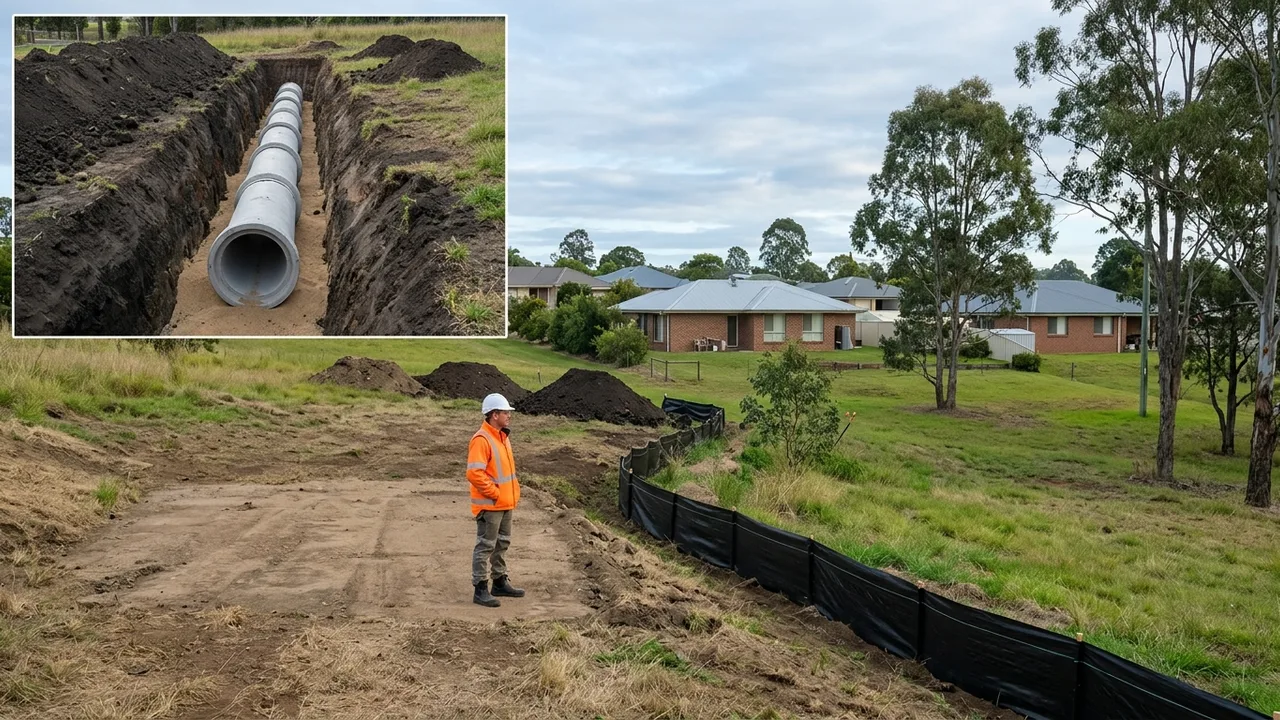
Stormwater Drainage Contractors in Toowoomba
Water sitting on your site or cutting into a batter needs a planned way out. Stormwater drainage contractors in Toowoomba build that path with pipes, pits and outfalls.
Pooling and washouts are fixed by giving water a planned path off the site. That means pipes, pits, outfalls and channels set to the levels on your engineer's drawings. When the fall is right, rain leaves the site instead of sitting against a slab or tearing at a batter, which is the sloped edge of a cut or fill.
What is included
- Stormwater pipes Buried pipe carries roof and surface water to the approved discharge point instead of letting it find its own way.
- Pits and collection points Pits catch water at low spots and let silt settle, so the pipes downstream stay clear.
- Outfalls and outlet protection Water leaving a pipe at speed scours the ground, so the outlet needs rock or a shaped apron to slow it.
- Open drains and channels Shaped channels and swales move water across a site where a buried pipe is not needed.
- Batter protection A cut-off drain at the top of a batter stops runoff pouring over the face and carving gullies.
- Repairs to failed drainage Blocked pipes, collapsed joints and washed-out edges are dug out and rebuilt to the right fall.
How it works
-
Read the site and the plans
The contractor walks the ground, looks at where water gathers and leaves, and works from your engineer's levels and drainage drawings.
-
Agree the scope and price
Pipe runs, pits, outfalls and any rock or pavement to cut are set out so the price matches the work.
-
Excavate and lay
Trenches are cut to grade, bedding is placed, pipes and pits go in, and the fall is checked as the run progresses.
-
Backfill and compact
Trenches are filled in layers and compacted so the ground above does not sink or wash into the line.
-
Finish the outlets and surface
Outfalls are protected, channels are shaped and disturbed ground is trimmed so water follows the intended path.
Stormwater drainage contractors in Toowoomba: stopping pooling and washouts
Pooling water and washed-out batters have the same root problem. Water arrives faster than the site can shed it, and it has nowhere planned to go.
A drainage contractor fixes that by working out where the water comes from, where it should end up and what has to be built between the two. Sometimes that is a single pit and a short pipe. On a subdivision stage or commercial site it is a full network of pipes, pits and outlets tied into the road and kerb.
The job suits builders waiting on a dry pad, owners with water against a slab, and developers whose council conditions call for drainage before sign off.
From a block in Newtown to a stage in Glenvale, Drayton or Rockville, the problem is the same: water needs a planned way off the site, and clay ground drains slowly when it does not get one.
Why water pools and batters wash out
Water pools where the ground is flat or dips below its surroundings, or where a pipe is blocked, undersized or laid without enough fall. Fall is the slope that keeps water moving. Too little and it sits. Too much and it scours.
Batters wash out when runoff pours over the top of the face instead of being caught above it. Bare soil has nothing holding it, so each storm carves the channel deeper.
The usual causes are a missing drain above the batter, outlets that dump water onto unprotected ground, fill that was not compacted and has settled, and pits or pipes that have silted up or been crushed. The contractor confirms which applies once they have seen the site.
Excavation and trenching for stormwater lines
Excavation is where a drainage job is won or lost. Each trench has to be dug to the depth and grade on the plans, because a pipe laid even slightly flat will hold water and silt.
Backhoes are the usual machine for pits, short runs and tight spots beside slabs and existing services. Larger excavators suit long runs and bulk work. The contractor chooses the machine to suit access, depth and the ground.
Bedding comes next. Pipes sit on a prepared base, and the backfill goes in layers that are compacted, so the trench does not settle into a dip that traps water later.
Detailed drainage work to your engineer's plans
Detailed drainage drawings show pipe sizes, invert levels (the height of the bottom of each pipe), pit locations and where the system discharges. A contractor builds to those figures, not to a rough guess on the day.
That is also why one crew for the whole scope helps. The same contractor who cuts and fills the site can lay the drainage, shape the channels and tie in kerb and channel, so levels line up between each stage.
What drives the cost of a drainage job
Cost follows the length and depth of the pipe runs, the number of pits, the pipe size and the type of ground. Rock, access for machines and the need to cut through concrete or road all add work. So does the distance to the discharge point.
A clear scope and price before machines arrive is the best protection. It names what is included, such as pits, outfall protection, backfill and reinstatement of the surface.
Licensing and council conditions
Stormwater work often sits under council conditions, especially on subdivisions and commercial sites, where drainage must connect to an approved point. Building approval is a matter for your building certifier or council, not the contractor.
Trade licensing depends on the work, so it is fair to ask the contractor which licences cover your site. Plumbing-related connections need a licensed plumber, and a contractor who does the civil side will usually work alongside one.
Getting your drainage job moving
Water on site holds up slabs, landscaping and sign off. Put in where the water pools, how the ground falls and any plans or council conditions you hold, then use Request a Project Review.
Stormwater and drainage options
- Stormwater pipe and pit installation New pipe runs, junction pits and inlets laid to the grades on the plans, then backfilled and compacted.
- Outfalls and channels Shaped drains, swales and rock-lined outlets that carry water away without scouring the ground.
- Batter and washout repair Reshaping eroded faces, rebuilding the edge and adding drainage above it so the damage does not return.
- Culvert and pipe repair Clearing, relaying or replacing blocked and damaged pipes where water crosses a road or driveway.
Stormwater and drainage across Toowoomba
Frequently Asked Questions
When does a stormwater or drainage defect on a Toowoomba site become urgent?
What damage does poor drainage cause on a site, such as erosion and washout?
What should culvert maintenance include on a stormwater system?
Get it priced
Site levels holding up your build? Send through your plans and get the earthworks moving.
Share the details and we will help you take the next step with confidence.