
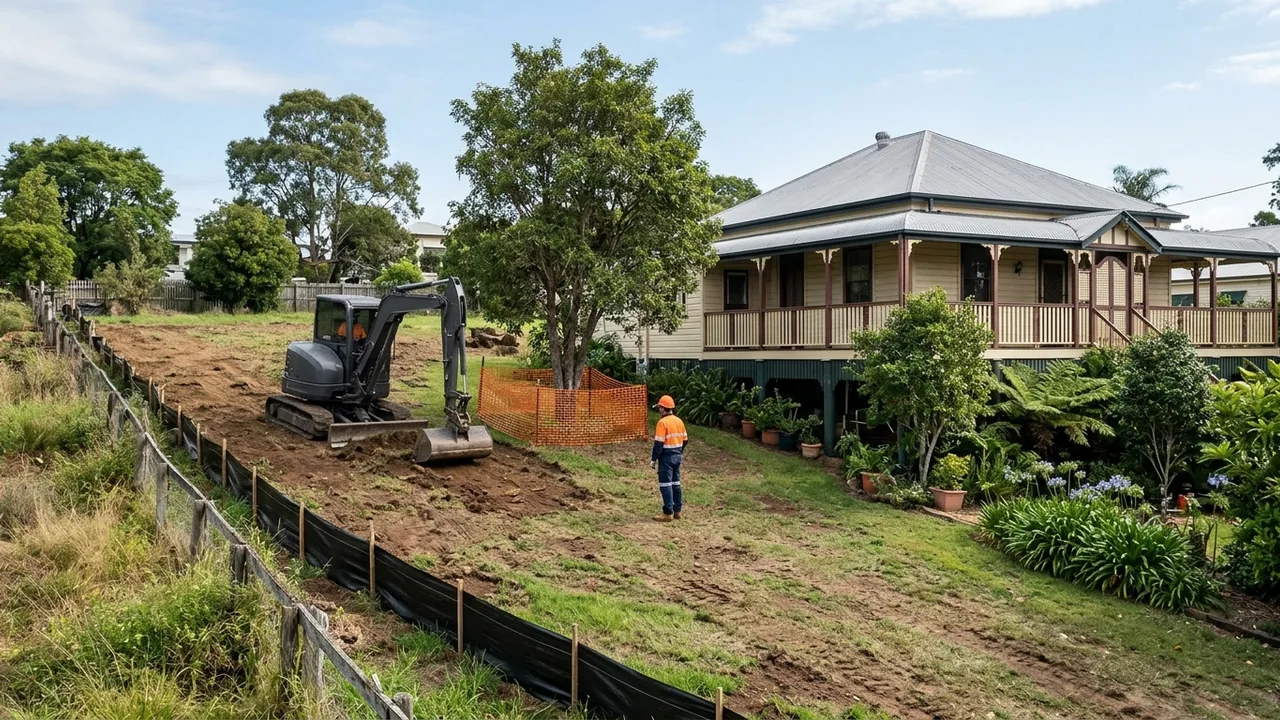
Civil Earthworks in South Toowoomba
Water pooling against a slab or a pad that is not ready holds up the whole build. Civil earthworks contractors who know South Toowoomba ground can cut, fill and drain your site to the engineer's plans.
Civil earthworks in South Toowoomba means shaping your block to the levels on the approved plans, building a compacted pad for the slab and getting stormwater away from the building. One contractor can often carry the cut and fill, the trenching and the drainage together. That keeps the builder from waiting on three separate trades.
Services in South Toowoomba
- Detailed excavation Precise digging for footings, foundations, trenches and services, cut to the levels and grades you need.
- Commercial site preparation and pads Clearing, cut and fill and compacted building pads for commercial sites, ready for the builder to start.
- Stormwater and drainage Pipes, pits, outfalls and channels that move stormwater off your site and away from slabs and batters.
- Bulk earthworks Cut and fill, soil removal and cartage to bring a large site to the design levels on your plans.
- Subdivision earthworks Lot formation, bulk earthworks, roads and drainage for new estates, built to the engineer's plans.
- Road construction and formation Estate roads, rural access roads, heavy duty pavements and kerb and channel built to engineered levels.
Civil earthworks in South Toowoomba: cut, fill and drainage
Most jobs start with the engineer's drawings. The contractor strips the surface, then cuts high ground and fills low ground until the site matches the design levels. Fill goes down in layers and is compacted as it goes, so the pad does not settle under the slab later.
Where your conditions call for it, fill is placed so it can be tested and certified. That paperwork is what lets the builder start with confidence.
Drainage is part of the same job. A pad that sits a little too flat, or a batter (the sloped edge of a cut or fill) with nowhere for runoff to go, will wash out in the first heavy storm. Good earthworks finish with water leaving the site rather than sitting against a wall.
The scope can be a single house pad, a knockdown and rebuild, or a larger site with roads, kerb and channel and services.
What does a block near East Creek or West Creek need?
A block close to either creek needs the drainage planned before the first cut. Water from the slopes above has to go somewhere, and a poorly shaped site sends it straight at your slab or onto your neighbour.
A contractor will look at how the ground falls, where runoff already travels and where it can safely leave. Swales (shallow shaped drains), pipes and grated pits are the usual tools. The right mix depends on the plans and on what the site shows once the topsoil is off.
If a batter is washing out, the usual causes are slope that is too steep, no cut-off drain above it, or bare soil with no cover. The contractor confirms the cause on site and reshapes the slope or adds drainage to suit.
Flood and creek overlays can shape what is allowed near the waterways. Your certifier or council decides that, and the earthworks are then built to the approved levels.
Pads, trenching and roads on older streets
Older streets mean tighter access. A truck turning into a narrow driveway, an excavator working beside an existing house or a trench running past mature trees all call for planning. A contractor who has worked across Toowoomba suburbs allows for this when setting out machines and spoil (the excavated soil) removal.
Trenching for water, sewer or power is common on rebuilds and subdivisions of larger old blocks. Trenches need correct depth, bedding and backfill, and they often sit close to other services. The contractor works to the plans and the service authority's requirements.
Where a development stage needs a new access road, kerb and channel or stormwater lines before sign off, the same crew can often handle that work too. Fewer handovers mean fewer gaps between trades.
How does Toowoomba clay behave after rain?
Clay soil swells when it is wet and shrinks as it dries. That movement can crack slabs and shift pads that were not built properly.
A good earthworks contractor works the ground at the right moisture, removes soft spots and compacts fill in layers. After a wet spell, they may leave a cut to drain before filling over it. The details are confirmed on site, because soil can change from one end of a block to the other.
If your slab date is near, tell the contractor how the ground has behaved and when the builder needs the pad.
What does the quote cover?
A clear quote names the cut and fill volumes, the pad size, the drainage work, any trenching and the clearing of spoil. It is agreed before machines arrive, so you know what the job includes.
Licensed contractors do the regulated parts of the work, such as drainage connections. Your builder or certifier can say which approvals apply to your site.
For a Project Review, give the contractor what you can type: the size of the block, how the ground falls, what stands there now and when the builder needs the pad.
South Toowoomba streets and creeks
East Creek marks the eastern edge of the suburb, and West Creek runs through the City Golf Club course. Any site near either creek needs its levels and drainage handled with care.
The New England Highway runs along Ruthven Street, right through the middle of South Toowoomba. Off it, a tight grid of older streets runs back to the CBD, with narrow blocks close to their neighbours and limited room for trucks.
That grid matters for earthworks. Sites near Toowoomba Hospital or St Patrick's Cathedral can have busy surrounding streets, so delivery of fill and removal of spoil are planned around traffic. On a block that slopes toward one of the creeks, the fall of the land decides where water goes, so the finished levels and drains are set with that in mind.
Frequently Asked Questions
How do I lodge a claim against Toowoomba Regional Council for damage near my South Toowoomba site?
Get it priced
Site levels holding up your build? Send through your plans and get the earthworks moving.
Share the details and we will help you take the next step with confidence.