
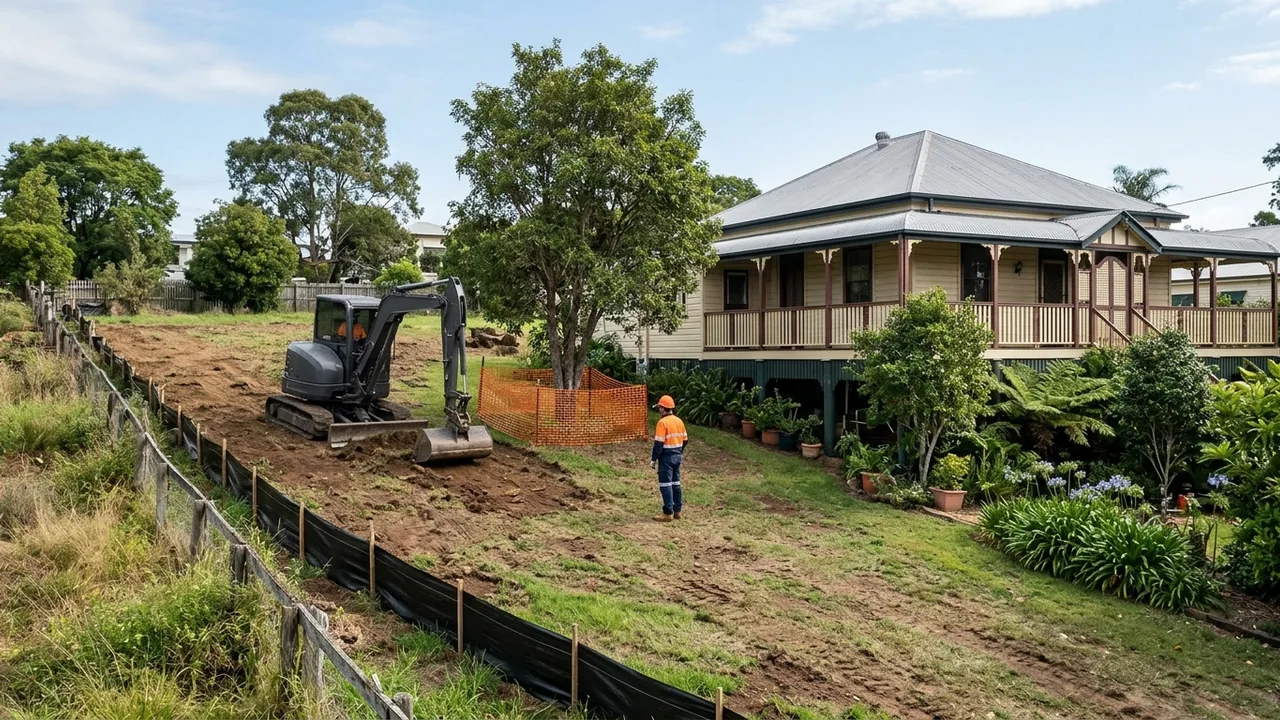
Civil Earthworks in Newtown, Toowoomba
Builder waiting on a pad, or water sitting against the slab on a tight Newtown block? Get the levels moving with a contractor who works around fences, neighbours and existing services.
Civil earthworks in Newtown mean cutting, filling and shaping a block that already has neighbours, fences and services around it. Pads, trenching, roads and stormwater all aim at the same result: levels that match your engineer's plans and water that leaves the site instead of sitting against a slab. One contractor who works across Toowoomba suburbs can often carry the whole scope.
Services in Newtown
- Subdivision earthworks Lot formation, bulk earthworks, roads and drainage for new estates, built to the engineer's plans.
- Road construction and formation Estate roads, rural access roads, heavy duty pavements and kerb and channel built to engineered levels.
- Detailed excavation Precise digging for footings, foundations, trenches and services, cut to the levels and grades you need.
- Commercial site preparation and pads Clearing, cut and fill and compacted building pads for commercial sites, ready for the builder to start.
- Stormwater and drainage Pipes, pits, outfalls and channels that move stormwater off your site and away from slabs and batters.
- Bulk earthworks Cut and fill, soil removal and cartage to bring a large site to the design levels on your plans.
Civil earthworks in Newtown: cut, fill, pads and drainage
Most Newtown jobs start with the levels on the engineer's drawings. Cutting removes soil from the high parts of the block. Filling builds up the low parts in layers, and each layer is compacted (pressed down firmly with a roller) so it does not settle later.
A building pad is the flat, compacted platform a slab sits on. The builder needs it finished to the design level before the formwork goes in. Where your conditions call for it, the fill can be tested and certified, which gives the certifier the paperwork they need.
Stormwater is the other half. Shaping the ground so water falls away from the house, and connecting drains where the plans show them, is part of the same job. Doing it at the earthworks stage costs far less than digging up a finished yard later.
What does an established site change about the work?
Access and neighbours change it most. A Newtown block close to the city often has a narrow frontage, existing fences and houses on both sides. That decides which machines can get in, where spoil (the excavated soil) is stacked and how many truck trips the job needs.
Old footings, buried pipes or earlier fill can sit under a site that has been built on before. A good contractor plans for the ground to be inspected as it is opened up, so anything old is dealt with as part of the agreed scope.
A smaller machine may suit a tight block, while a larger site can take a bigger excavator and finish sooner. The contractor matches the equipment to the job, not the other way round.
Excavation and trenching for water, sewer and power
Trenching is narrow excavation to carry services to the building. Water, sewer and power each need a set depth, grade and bedding, and the trench has to be backfilled and compacted so the ground above it does not sink.
Sewer lines depend on fall. If the grade is wrong, the pipe will not drain properly, so the trench is cut to the levels shown on the plans. Detailed earthworks around the building, such as footing trenches and drain runs, follow the same rule.
Where a trench crosses an existing driveway or garden, the contractor works out the order of the job so the site is left usable. Licensed tradespeople handle the regulated pipework and electrical connection once the trench is ready.
How does Toowoomba clay behave after rain?
Clay soils swell when wet and shrink as they dry. That movement is why a pad needs proper compaction and why water must be kept away from the edges of a slab.
After heavy rain, a cut or batter (a sloped edge of earth) can slump or wash out if water runs down it. Contractors who work in Toowoomba shape the site so water drains to a planned point, and they avoid working clay when it is saturated.
If stormwater is already pooling on your block or eating into a slope, the cause is usually the way the ground falls or a missing drain. The contractor confirms the cause on site.
Newtown sites near Clifford Park and West Street
Newtown is a residential suburb immediately west of central Toowoomba, so trucks and machines arrive on streets that are already busy with local traffic. Newtown Primary is one of several schools in the area, which makes drop-off and pick-up hours worth planning truck movements around.
The suburb grew up close enough to town for people to walk in. In 1899 St Mary's Christian Brothers Boys' College was built on West Street, and that history shows in the older blocks, with established boundaries and mature services. Work on these sites is usually infill: one pad, one drainage fix or one set of trenches at a time.
Clifford Park, Toowoomba's metropolitan racecourse, sits at the suburb's edge. Blocks out that way can have more open ground to work with than the tight lots closer to town, which affects machine size and how fill is brought in. Across Newtown 4350, each block's fall sets its own levels.
Earthworks contractors working in Newtown also cover Drayton, Harristown and East Toowoomba. Give the block's address, say how the ground falls and what the plans call for, then request a project review.
Frequently Asked Questions
How do I lodge a complaint with Toowoomba Regional Council about a Newtown site?
Get it priced
Site levels holding up your build? Send through your plans and get the earthworks moving.
Share the details and we will help you take the next step with confidence.