
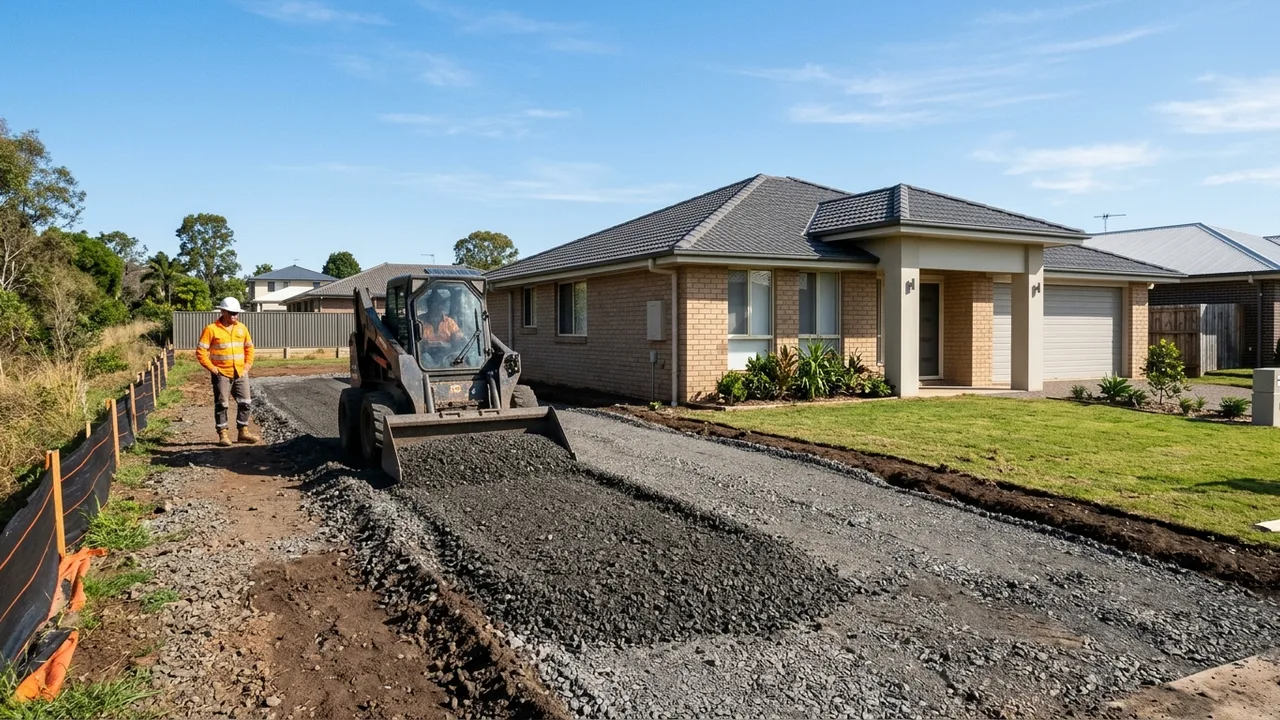
Civil Earthworks in Glenvale
The builder cannot start until your Glenvale block matches the engineer's levels. Civil earthworks in Glenvale cut, fill and compact the pad so the slab can go in.
A Glenvale block gets cut and padded by an earthworks contractor who works to the engineer's levels, places and compacts the fill, and leaves a flat pad ready for the slab. That is the core of house pad works in the new estates on Toowoomba's western edge. Drainage, trenching and access tracks often come in the same visit, so the site is ready for the builder in one go.
Services in Glenvale
- Commercial site preparation and pads Clearing, cut and fill and compacted building pads for commercial sites, ready for the builder to start.
- Stormwater and drainage Pipes, pits, outfalls and channels that move stormwater off your site and away from slabs and batters.
- Bulk earthworks Cut and fill, soil removal and cartage to bring a large site to the design levels on your plans.
- Subdivision earthworks Lot formation, bulk earthworks, roads and drainage for new estates, built to the engineer's plans.
- Road construction and formation Estate roads, rural access roads, heavy duty pavements and kerb and channel built to engineered levels.
- Detailed excavation Precise digging for footings, foundations, trenches and services, cut to the levels and grades you need.
Civil earthworks in Glenvale: cut, fill and pads for new blocks
Most Glenvale jobs start with a set of approved plans and a block that does not match them yet. The ground is higher in one corner, lower in another, and the slab needs to sit on a level, firm base.
The contractor strips the topsoil, cuts the high ground to the design levels and builds up the low ground with fill. Fill is imported or reused soil, laid in layers and compacted so it does not settle under the slab. Where your conditions call for it, the fill is tested and certified.
A single house pad is a small job. A subdivision stage with bulk earthworks, roads and services is a large one. The same contractor can often handle both, with machines and crew matched to the size of the site.
What house pad works involve
House pad works prepare the exact footprint the builder will pour on. The pad is cut or filled to the finished floor level on the plans, shaped with a fall away from the building, and compacted.
The fall matters. A pad that is flat but has no slope around it leaves water sitting against the slab edge, which is how damp and movement problems start. Your engineer's drawings show the levels, and a qualified operator works to them with a laser or GPS grade control.
On steeper lots the pad may need a retaining batter, which is a sloped cut or fill face, or a small retaining wall. The plans show which one applies to your block.
Drainage, trenching and roads on a Glenvale stage
Water has to go somewhere once the site is stripped and shaped. Stormwater pipes, swales (shallow grassed channels) and kerb and channel carry runoff away from the pads and out to the street or a detention area.
Trenching is the other half. Water, sewer and power need trenches cut to the right depth and grade before the building can connect. Sewer is the fussy one, because it relies on a steady fall to flow properly.
When council conditions call for roads, kerb and drainage before sign off, one crew doing the cut, the pipes and the road base keeps the stage moving instead of waiting on several trades.
How clay and slope shape the work
Clay soils hold water, soften after rain and can swell and shrink as they wet and dry. That affects when machines can work and how the base is prepared.
A wet clay surface cannot be compacted properly, so a good operator waits for it to firm up or treats it. Pushing on in the mud leaves soft spots that show up later as cracks in a slab.
Slope adds to this. Runoff from higher ground can wash out a fresh batter if drainage is not in place first, so the order of work counts as much as the machines used.
What does excavation cost around Toowoomba?
Published Toowoomba figures from ateamgroup.au, as at October 2026, give a feel for the range. Site clearing runs from $2,000 to $10,000. Soil excavation and removal runs from $1,500 to $5,000 per day. Bulk earthworks run from $10,000 to $50,000.
Detailed excavation sits between $3,000 and $15,000, and compaction and grading between $2,500 and $10,000. Landscaping preparation runs from $1,000 to $5,000.
The spread is wide because volume, access, rock, haul distance and the finished levels all move the price. A written scope and price for your block sets what is covered before machines arrive.
Earthworks on Glenvale's growing western edge
Glenvale sits about 7.5 kilometres from the CBD, around 600 metres up on the Great Dividing Range. That elevation means slopes and run-off paths are part of nearly every block, so drainage planning goes in alongside the pad.
The suburb is changing fast. Glenvale has grown quickly as new estates replaced former farmland. Paddocks that were once grazing land are now being cut into lots, which makes bulk earthworks and roadworks a regular part of the picture.
The western edge is a patchwork. Established streets such as Gainsborough Drive give way to modern estates, very large holdings and the Toowoomba Showgrounds. Near Glenvale State School, Nash Drive Park and Riethmuller Park, access for trucks and machines is something the contractor plans around, so that neighbours and school traffic are kept in mind.
If the levels are holding up your build in one of these estates, request a project review and give the lot size, how the ground falls and what the plans call for.
Frequently Asked Questions
What should a Glenvale civil earthworks quote itemise?
Get it priced
Site levels holding up your build? Send through your plans and get the earthworks moving.
Share the details and we will help you take the next step with confidence.