
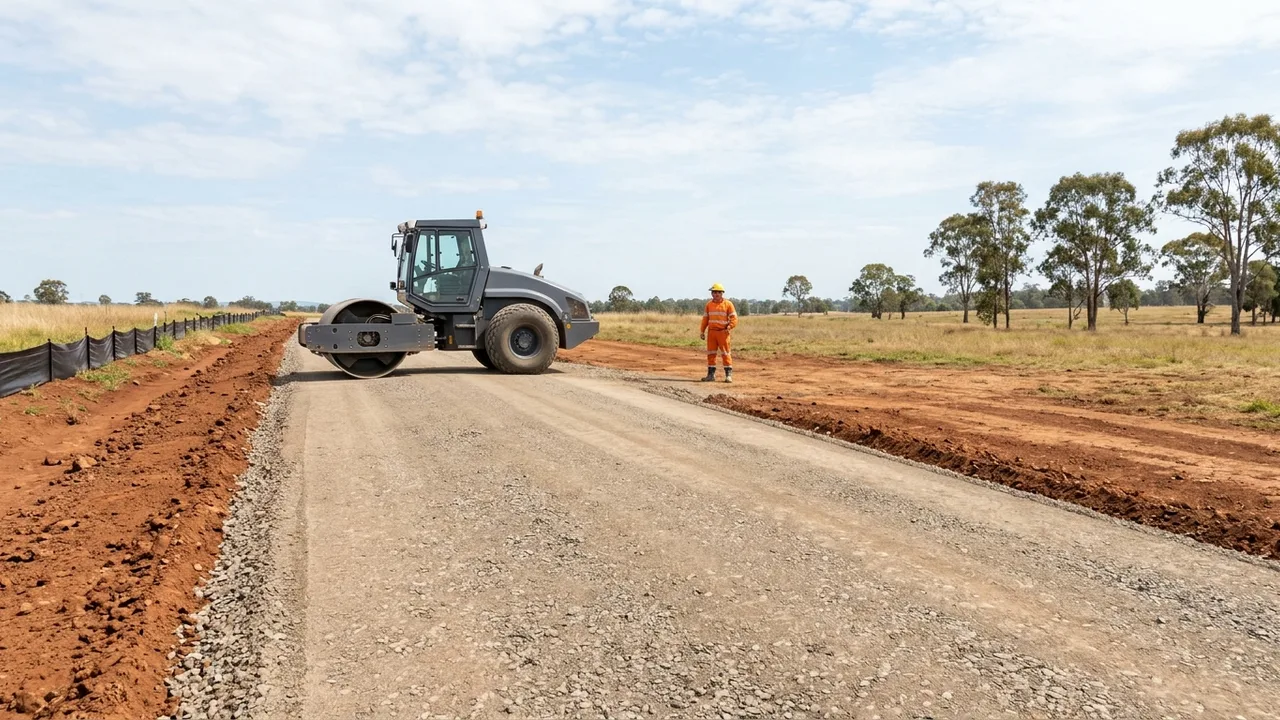
Road Construction Contractors in Toowoomba
Plans approved, but the stage is waiting on a road, kerb and drainage before council will sign off? Road construction contractors in Toowoomba take the job from first cut to handover.
Before an estate stage, rural block or commercial site can open or pass council sign off, it needs a formed road, a pavement that holds up and kerb that carries water away. The work follows your engineer's plans and design levels. One earthworks crew can often take the road from first cut through to finished channel, which keeps the stage from stalling between trades.
What is included
- Estate road formation Cutting and filling to design levels gives the road a stable shape before any pavement layers go on.
- Rural access roads Farm and acreage roads need a firm base and crowned surface so they shed rain instead of rutting.
- Heavy duty pavements Trucks and machinery load a pavement far harder than cars, so the layers are built thicker and compacted in stages.
- Kerb and channel The concrete edge and gutter carries runoff along the road to the pits and keeps water off the pavement edge.
- Drainage connections Pits, pipes and culverts take water away from the road so it does not pond or wash out the batter.
How it works
-
Plans and levels
The contractor reads the engineer's drawings, the design levels and any council conditions, then sets out the road line.
-
Excavation and subgrade
Topsoil and soft ground come out, and the subgrade (the natural ground under the road) is trimmed and compacted.
-
Pavement layers
Gravel goes down in compacted layers, shaped with a grader to the crossfall and thickness on the plans.
-
Kerb, channel and drainage
Kerb and channel is formed and connected to pits and pipes so water has a clear path out.
-
Testing and handover
Levels and compaction are checked against the design, with testing where your conditions call for it.
Road construction contractors in Toowoomba: roads, kerb and pavements
The right contractor is one who builds the whole road, not just a slice of it. That means formation, pavement layers, kerb and channel and the drainage that serves them.
Estate stages need streets that meet council conditions. Rural owners need access roads that survive heavy rain and loaded trucks. Commercial sites need pavements that take constant heavy traffic.
Road projects come up right across Toowoomba, from Glenvale and Drayton to Harristown, Rockville, East Toowoomba, Newtown and North Toowoomba. Size matters little to the method. A short rural entry and a full subdivision street both start with the plans and finish with levels that match them.
Excavation and subgrade: where a good road starts
A road is only as firm as the ground under it. Excavation removes topsoil, roots and soft patches, then the exposed subgrade is rolled and trimmed to shape.
Reactive clay soils swell when wet and shrink as they dry, so a soft spot left in place tends to show up later as a dip or crack in the pavement. Weak areas are usually dug out and replaced with compacted fill. The contractor confirms what the ground needs once machines are on site.
Graders then trim the surface to the crossfall, which is the sideways slope that sends rain off the road. Getting this right early saves rework once the gravel is down.
Detailed kerb and channel works
Kerb and channel is the raised edge and the shallow gutter beside it. Its job is to hold water on the road edge and carry it to the nearest pit.
The fall along the gutter has to be right. Too flat and water sits and softens the pavement edge. Too steep and it runs fast and scours. Detailed setting out from the plans keeps the gutter falling the way the stormwater design expects.
Kerb is usually formed after the pavement base is shaped and before the final surface goes on. Driveway crossovers and pit lids are set at this stage too, so they sit flush.
Heavy duty pavements for trucks and commercial sites
A heavy duty pavement is built thicker and compacted harder than a standard road. It suits yards, car parks, haul routes and industrial access where loaded trucks turn and brake.
The engineer sets the layer depths and material. The crew places each layer, waters it and rolls it until it is dense enough to carry the load. Shortcuts here show up as rutting and potholes after the first wet season.
Where a surface such as asphalt or concrete goes on top, the base under it needs to be even and well drained. Water trapped in the base is what breaks most pavements down.
What drives the cost of road works
Cost follows the length and width of the road, the depth of the pavement and how much ground has to be cut or filled. Soft subgrade that needs replacing adds material and machine time.
Drainage also moves the price. Pits, pipes, culverts and kerb are separate items of work, and long hauls of gravel add up. Access matters too, since tight sites slow the machines.
A clear scope and price before machines arrive sets out what the quote covers for your road. Having one crew handle the cut, drainage and road avoids paying for the same site establishment more than once.
Mistakes that hold up a road job
Starting pavement before the drainage is in is the costly one, because trenches get cut through finished work. Building to the wrong levels is another, so the plans should be settled first.
Skipping compaction testing where council asks for it can stall sign off. Hiring separate trades for cut, pipe and road also leaves gaps in who owns the levels.
When your plans are approved and the stage is waiting on a road, use Request a Project Review and give the length of road, the ground and what is on site now.
Road construction and formation options
- Roads and heavy duty pavements Haul routes and commercial hardstand need a thicker, harder compacted base than a quiet estate street because of the loads they carry.
- Kerb and channel works Formed concrete kerb and gutter set to the falls on the plans, tied into stormwater pits.
- Rural access roads A crowned surface and side drains keep farm tracks and acreage entries from holding water after rain.
- Road works with drainage Culverts, pits and pipes go in before the final pavement layers so trenches are not cut through finished work.
Road construction and formation across Toowoomba
Frequently Asked Questions
What are civil works on a Toowoomba road or estate job?
What does civil works mean in construction for a road project?
What are common civil works challenges on Toowoomba roads and how are they solved?
Get it priced
Site levels holding up your build? Send through your plans and get the earthworks moving.
Share the details and we will help you take the next step with confidence.