
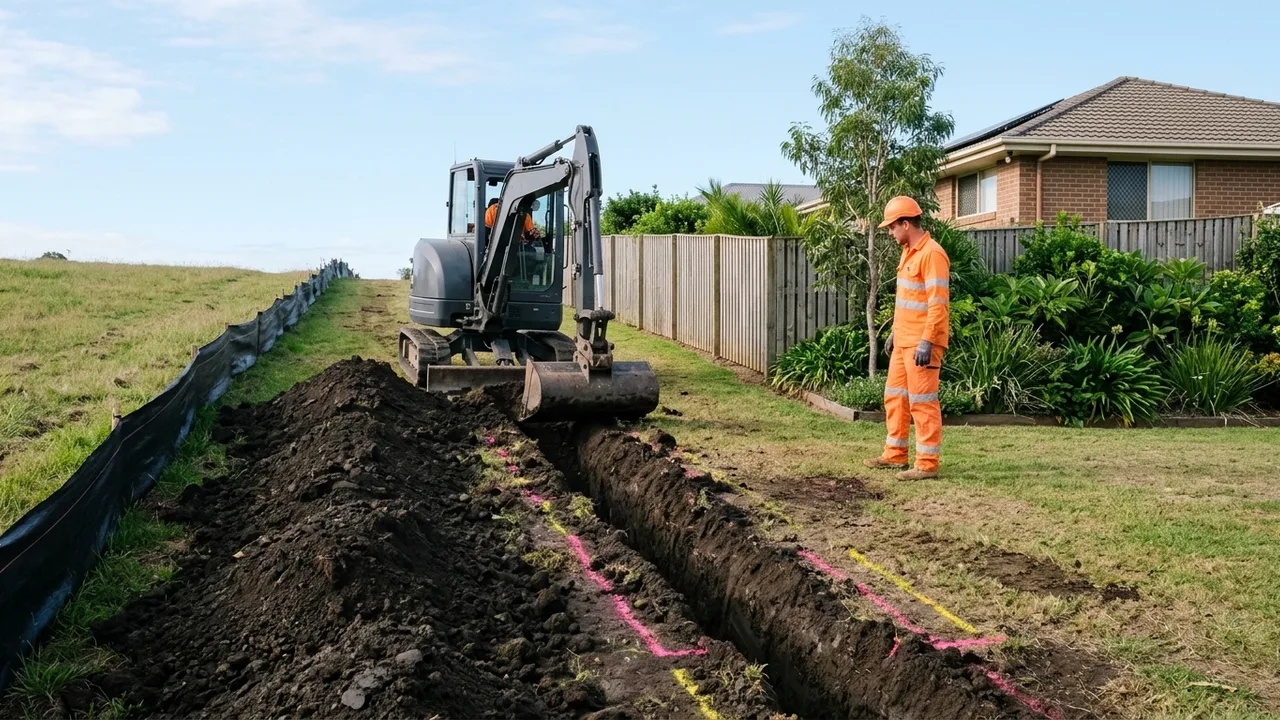
Excavation Contractors in Toowoomba
Builder waiting on footings, or a trench that has to fall just right? A few centimetres out and the slab sits wrong or the pipe won't drain, so excavation contractors in Toowoomba cut to the levels on your plans.
Excavation contractors in Toowoomba dig footings, trenches and house pad cuts to the levels on your engineer's drawings. Detailed excavation is slow, careful digging where a few centimetres decide whether a slab sits flat or a pipe falls the right way. It suits a builder waiting on footings, an owner running services to a new shed, or a site where drainage has to fall to a set point.
What is included
- Footings and foundations Trench width and depth must match the engineer's detail so the concrete bears on sound ground.
- Service trenches Water, sewer and power runs need a consistent grade and a clean base before pipe or cable goes in.
- House pad cuts The pad is trimmed to design level so the slab can be formed without extra fill or hand work.
- Drainage and channel cuts Drainage trenches need an even fall the whole way, or water pools in the low spots instead of leaving the site.
- Deep excavations Basements, tanks and deeper cuts need batters or shoring planned before the first bucket.
How it works
-
Read the plans
The contractor goes through the engineer's drawings and the levels, then looks at the site to see access, slope and what stands there now.
-
Agree the scope
You get a clear scope and price covering the digging, spoil removal and any trimming to level before machines arrive.
-
Set out and dig
Pegs and levels mark each footing or trench. Excavators cut to depth, then the operator trims by hand or with a smaller bucket where accuracy matters.
-
Check and hand over
Depths and falls are checked against the plans so the builder, plumber or electrician can start on a ready trench.
Excavation contractors in Toowoomba: footings, trenches and pads
Good excavation contractors do more than move dirt. They cut to a number. A footing trench that is 100 millimetres too deep wastes concrete, and one that is too shallow can fail inspection.
The usual jobs are footings for a house or shed, trenches for water, sewer, stormwater and power, and the cut for a house pad. Most of these sit inside a larger build, so the digging has to match the builder's timetable as well as the drawings.
Excavators do the heavy work, and the operator finishes with fine trimming. The aim is a trench with a clean base and straight sides, ready for steel, pipe or cable without anyone reworking it.
Detailed excavation compared with bulk earthworks
Detailed excavation is about accuracy. Bulk earthworks is about volume. Cutting and filling a whole subdivision stage moves thousands of tonnes to broad design levels. Digging a footing or a sewer trench moves far less soil but leaves far less room for error.
Most projects need both. The bulk work shapes the site, then detailed excavation cuts the footings and trenches into the finished surface. One crew handling both avoids gaps where each trade assumes the other has set the levels.
When the same machines and operator stay on site for both stages, you avoid paying for a second float-in.
What drives the cost of detailed excavation
Depth, length and access set most of the price. A long, deep trench takes more machine time than a short shallow one. A tight backyard that only fits a small excavator costs more per metre than an open block.
Ground matters too. Clay, rock and loose fill each dig differently, and rock may call for a breaker attachment. Spoil is another line: soil can be spread on site, stockpiled or carted away, and carting costs more.
A written scope and price lists these items before work starts, so you know what the quote covers.
Digging in clay ground and sloping blocks
Clay ground holds its shape when dry and turns soft after rain. Trench walls can slump, and a wet base loses the firm bearing a footing needs. An operator who knows the local ground will time the cut around weather and keep the base protected.
Sloping blocks add another layer. Footings may step down the slope, and cut batters need safe angles. Deep excavations need planned support or sloped sides so the walls stay stable while people work in them.
The contractor confirms the approach on site once the ground and levels have been seen.
Services, approvals and who does what
Connecting water or sewer is regulated work, so licensed specialists handle the pipework while the excavation contractor prepares the trench. Whether a building approval is needed is decided by your building certifier, and council decides planning matters.
For a clear start, say what you are building, how long the trench run is and how the ground falls. Put your suburb in the message too. Then request a project review.
Detailed excavation options
- Footing and slab excavation Trenches and edge beams cut to the depth and width shown on the structural plans.
- Trenching for services Narrow, graded trenches for water, sewer, stormwater and power, with bedding ready for the installer.
- Deep and specialist digging Deep excavations, pipelines and channel cuts planned around ground conditions and safe batter angles.
Detailed excavation across Toowoomba
Frequently Asked Questions
How long does excavation take on a Toowoomba job?
What is the difference between excavation and earthworks?
How should a trench with underground services be backfilled?
Get it priced
Site levels holding up your build? Send through your plans and get the earthworks moving.
Share the details and we will help you take the next step with confidence.