
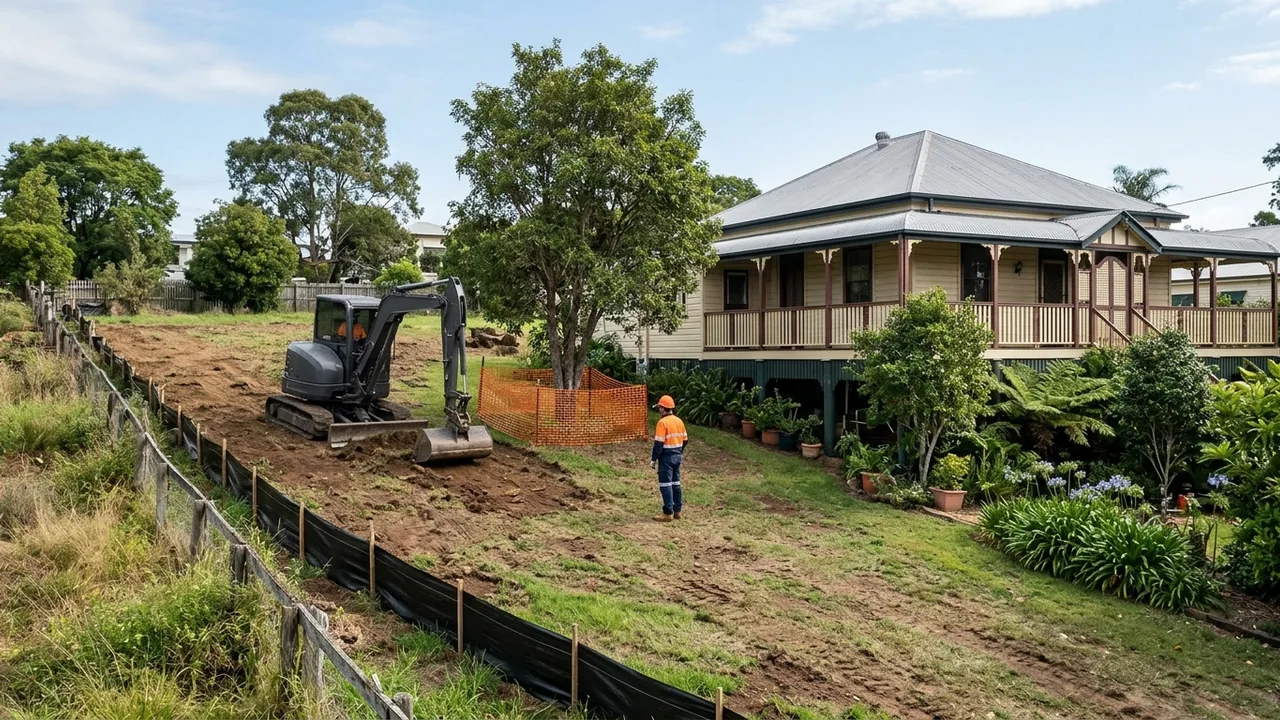
Civil Earthworks in Wilsonton, Toowoomba
Site levels holding up your build? A Wilsonton earthworks contractor cuts, fills and compacts to your engineer's plans so the slab can go in.
Your builder cannot pour until the pad is at level, compacted and certified, and civil earthworks in Wilsonton is the work that gets it there. On a local block that usually means sorting cut and fill, drainage and any old slabs or pipes first. Independent Toowoomba contractors shape house pads, industrial lots and staged developments across Wilsonton 4350 to the levels on your engineer's plans, leaving clear access for the builder. The work suits a single residential block just as well as a larger commercial site.
Services in Wilsonton
- Stormwater and drainage Pipes, pits, outfalls and channels that move stormwater off your site and away from slabs and batters.
- Bulk earthworks Cut and fill, soil removal and cartage to bring a large site to the design levels on your plans.
- Subdivision earthworks Lot formation, bulk earthworks, roads and drainage for new estates, built to the engineer's plans.
- Road construction and formation Estate roads, rural access roads, heavy duty pavements and kerb and channel built to engineered levels.
- Detailed excavation Precise digging for footings, foundations, trenches and services, cut to the levels and grades you need.
- Commercial site preparation and pads Clearing, cut and fill and compacted building pads for commercial sites, ready for the builder to start.
Civil earthworks in Wilsonton: cut, fill, pads and drainage
Cut and fill is the core of the job. Cutting removes soil from the high parts of a block. Filling builds up the low parts with imported or site-won material. Both are worked to the design levels shown on the approved plans.
Fill is placed in layers and compacted as it goes. Compaction squeezes out air and packs the material tight, so the pad does not settle under a slab. Where your council conditions call for it, the fill is tested and certified so the builder and certifier have the paperwork they need.
Drainage is part of the same scope. Water that sits against a slab or washes out a batter (the sloped face of a cut or fill) causes trouble for years. A good contractor shapes the site so water runs off it, then adds pipes, swales or pits where the levels alone cannot do the job.
Trenching for water, sewer or power is often done in the same visit. The trench itself is earthworks. The pipe or cable connection is regulated work, and licensed trades handle that part.
Excavation for industrial lots near Taylor Street and Boundary Street
Wilsonton has an industrial area in its south-west corner, bounded by Taylor Street and Boundary Street. Industrial earthworks differ from a house pad in a few ways that matter to the owner.
A warehouse or workshop slab carries heavy loads, so the base under it needs to be firm and even. Truck hardstand and turning areas need the same care, with falls built in so rain leaves the surface instead of ponding. Stormwater from a large roof and a sealed yard also adds up quickly, so drainage is planned early.
Services usually cross the whole lot. Trenches for water, sewer and power are cut after the pad levels are set, in an order that avoids digging up finished work.
One crew that can handle the bulk cut and fill, the excavation, the drainage and the access road keeps the program in one place. That is often easier for an owner than coordinating several trades on a commercial site.
Older streets, brick estates and newer lots
Wilsonton's housing shows several layers. Older timber and post-war houses sit through the eastern and south-eastern streets. Brick homes from the 1970s and 1980s are prominent around the airport-side estates, and newer development runs through the Fairview Heights side.
Those differences change the earthworks. An older block being cleared for a rebuild may carry old slabs, footings or buried pipes that must come out before a new pad is formed. A contractor looks at what stands on the lot now, then writes that work into the scope.
Newer estate lots are usually more regular, with levels that suit a standard slab. They still need the pad cut and compacted to the engineer's design, and drainage worked out so water leaves the block toward the street or the approved discharge point.
A sloping lot may need a retained cut or a built-up pad. The plans show which.
How Toowoomba clay behaves after rain
Clay soil holds water, and it moves. It swells when wet and shrinks as it dries, which is why levels, compaction and drainage matter so much on a Wilsonton block.
After heavy rain, a cut face can turn soft and slippery, and a half-finished pad can hold water for days. Earthworks crews work with that. They shape the surface so rain runs off, avoid compacting wet material, and protect exposed batters from washing out.
The builder benefits too. A pad that is properly compacted and drained gives the slab a steady base, and water directed away from the edges keeps the soil around the footings from swinging between wet and dry.
Nobody can promise a clay site stays perfectly still. A contractor who knows local ground works to reduce movement and gives the engineer and builder a base they can rely on.
What a clear scope and quote covers
A good earthworks quote names what is being done and where. It sets out the cut and fill volumes shown on the plans, the compaction and testing, the drainage and any trenching, roads or kerb and channel. You see the scope and the price before machines arrive.
Sewer, water and electrical connections are licensed work, so those trades come in alongside the earthworks contractor.
The cost of a job depends on the size of the site, how much soil moves, how far fill travels, the access for machines and the drainage and certification needed. Those factors, not a rough rate per square metre, shape the quote for a Wilsonton lot.
Getting machines to a Wilsonton site
Wilsonton sits 5.9 kilometres by road north-west of the Toowoomba CBD, so plant and trucks coming from the city cover a modest distance. Toowoomba City Aerodrome is the centre of the suburb and is reached via Mutze Street, so trucks heading to nearby lots work around that approach.
Street width, driveway slope and room to turn a truck decide how a contractor stages the job. A block near Airport Estate Park or Freighter Avenue Park has its own fall and access, and the machine size is chosen to suit.
If your block is in the south-west corner near Taylor Street and Boundary Street, expect industrial access to suit larger machines. Request a Project Review and type in the lot size, what stands there now and how the ground falls.
Frequently Asked Questions
How can a Wilsonton earthworks programme account for operating businesses nearby?
Get it priced
Site levels holding up your build? Send through your plans and get the earthworks moving.
Share the details and we will help you take the next step with confidence.